
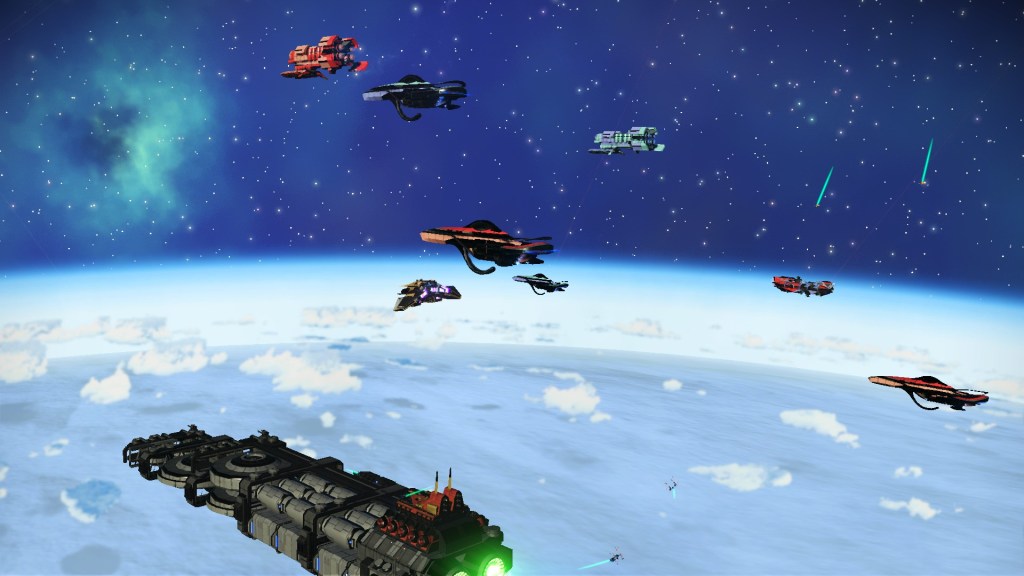

In 2016 I was a younger man and much more easily swept up in hype and E3 footage.
Boy was I naïve.
So when I pre-ordered No Man’s Sky (NMS) by Hello Games, wrapped up in the promises of endless planets to explore, endless numbers of procedurally generated animals to discover and see, and a pilgrimage to the center of the galaxy.
I won’t belabor the disappointments that came from the launch-edition “mile wide, inch-deep” version of this game, (since there’s a plethora of reviews from that era destroying the game) but instead talk about my experiences with the game in anno domini twenty twenty-three.
Starting Over (Again)
Any time I pick up a game after a long time away (even if it’s a game I’ve spent hundreds of hours with previously) I always have to start from scratch. So it was with this current playthrough of NMS. New game, survival difficulty, permadeath off. Boom, universe is being generated, and suddenly my player character wakes up with critically damaged equipment on a dangerously icy planet. So the adventure begins again.
Initially I’m immediately struck by just how much I love the art style of the game. It manages to toe this line between just cartoony enough that I don’t feel like I’m in an honest to goodness 1 to 1 space exploration game (like Elite Dangerous) but also not so cartoony that I feel like I’m playing Viva Piñata for the Xbox 360. In fact, one of the things that I remember from my first time through was being impressed with the variety in the color palette. Too many games from that era would have one cinematic filter (brown or gray) and stick with it throughout. This could dull or otherwise sort of smear out environments. NMS is a colorful game and it knows it.
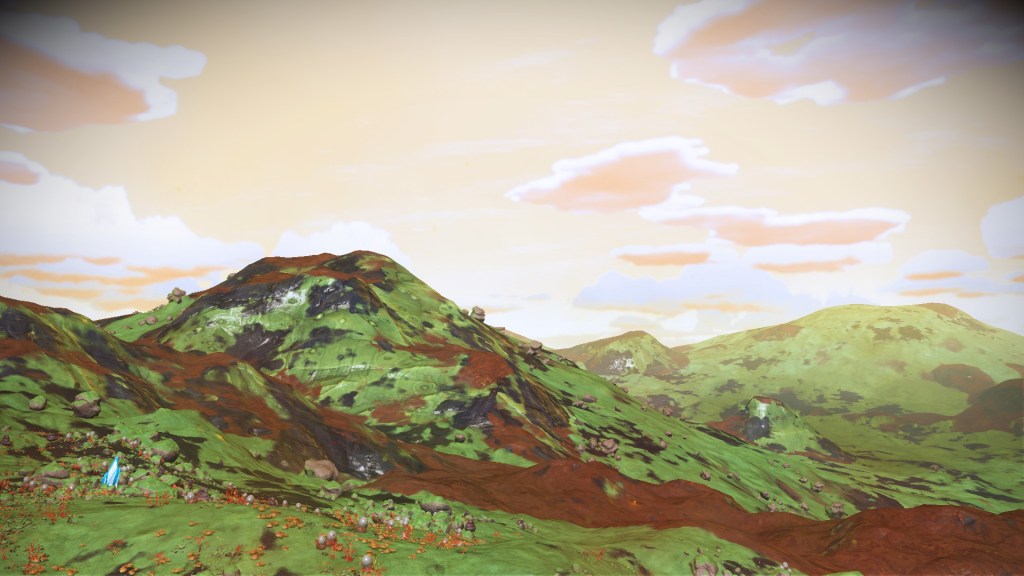
The psuedo-tutorial main quest takes a new player through step by step and explains many of the games mechanics in an unobtrusive and intuitive way. From how you mine materials, earn credits, and even craft and upgrade your equipment, it takes you step by step so that you never feel lost in the sandbox. They toe the line nearly perfectly with guiding a player, but also giving them plenty of agency and allowing them to decide what they’re going to be spending their game-time doing.
The game has a robust crafting system and something in the area of five hundred discoverable resources to be gathered. These resources can be used as fuel for the player’s various technologies, turned into lucrative objects to sell, or to build and upgrade bases. The more advanced the technology, the more advanced the resources needed to install or build it. On the bright side, the player is able to pin a recipe in their journal and the game will once again gently nudge them into exactly where to find those components.
The only downside to this for me was that each installable piece of technology or upgrade popped itself into my log right at the front and I felt the insane completionist desire each time to drop whatever I was doing in that moment and immediately gather 250 phosphorous (even if that led to its own forty-five minute adventure) with plenty of distractions along the way. In this sense the game has more than addressed both mine and critics’ original issue with the game. Now there’s pretty much always something to be done.
The Gameplay Loop
One of the most important aspects of a game, especially a sandbox, is the gameplay loop. NMS in its current state has this basic principle down pat. While the game does require the player to make a decision when the boot it up as to exactly what they want to be doing (piracy, trading, building a base, exploring, cataloging plant-life, etc., etc.) the game itself manages to always have something in your log book to nudge you to a goal. But how do you get to that goal?
That’s where the loop comes in. Unless you’re playing the game in creative mode to build some awesome megastructure, pretty much everything you are going to do requires resources. Your ship needs resources to take off, your life support systems and hazard support systems each need a separate resource to stay charged (and to keep you alive), and there’s always money to be made.
In order to make said money, and to make it faster, you’re constantly on the lookout for rare materials and technology that can boost your survival, make your weapons beefier, increase your cargo space, and so on and so forth.
Some of the higher tech upgrades require you to refine commonly found resources at less than favorable ratios resulting in you scouring planets and star systems for more and more resources. Depending on the difficulty you choose to play, resources can be plentiful or scarce, but with the size of each planet and the procedurally generated terrain, usually the limiting factor is time, meaning that if you’re willing to put the time in, everything is achievable. Theoretically, you could even explore every planet in every galaxy (given immortality.)
This brings me to…
The Story
If you haven’t had the chance to play the game yet, I would recommend going into the story totally blind at least once. If you’ve done so or you are okay with spoilers, you can read the section below. Otherwise skip to the next section.
Spoilers Below
When I first played the game, there wasn’t much of a story that I can recall. It was more Minecraft-esque in the sense that it was about exploration and crafting. As discussed above that element has changed quite a bit, even extending to the very early game. From the very first text box that pops up in the story, there’s an air of mystery and a more-than-sufficient hook to get you up, exploring, and in space.
Following the threads of a mysterious transmission you meet other “Travelers,” entities that traverse the stars. These Travelers don’t look anything like the three main species inhabiting the world of NMS, which is the first hint that there is something special about them (and by extension, you.) The first of these is Artemis, a friendly explorer who is stranded and needs you to help them get un-stranded. Along the way, you get contacted by the Space Anomaly, a death star like space orb that doesn’t really obey the rules of time and space. The anomaly acts as the central multiplayer hub and has terminals to let you use nanites to purchase upgrade blueprints to all of your gear.
The second Traveler to contact you is Apollo, a robotic figure who seems to be aloof to everything except making money, until he perks up to hearing you’re looking for Artemis. Then he helps you navigate the base building and research mechanic while you’re still looking for Artemis. While all of this is going on, you pick up snippets about The Crimson Eye and the number 16 pops up a lot. Eventually he shows you how to use the mysterious portals that exist on some planets. These can teleport you vast distances much quicker than even your hyperdrive. He says he can get you to the source of Artemis’ transmission.
Ignoring your character’s ominous feeling, you go through the portal and when you hone in on Artemis’ signal you find a grave instead. Somehow she’s been contacting you from beyond the grave. Right as you begin to lament, the third and final Traveler -null- reaches out to you and tells you that she can be saved… in a sense. In a cyber punk horror sense even, you download them into a device called the soul arc. Once this is done you get to make one of the few impactful choices in the story; you either put Artemis into a simulation of a universe aboard the space anomaly or you let them die a true death.
Whichever you choose, -null- (who seems to know more about what’s going on) sends you to get the histories of the primary three races of the NMS universe: The mercantile Gek, the calculating Korvax, and the war-like Vy’keen. Chances are good that you’ve encountered all three of these races and begun to pick up on their histories and lore, but if you haven’t the game does a quick and dirty summation and then you proceed to discover that the histories that they hold dear are fabrications in one way or another. You also find that the histories and religious beliefs of all these life forms ties into the Atlas.
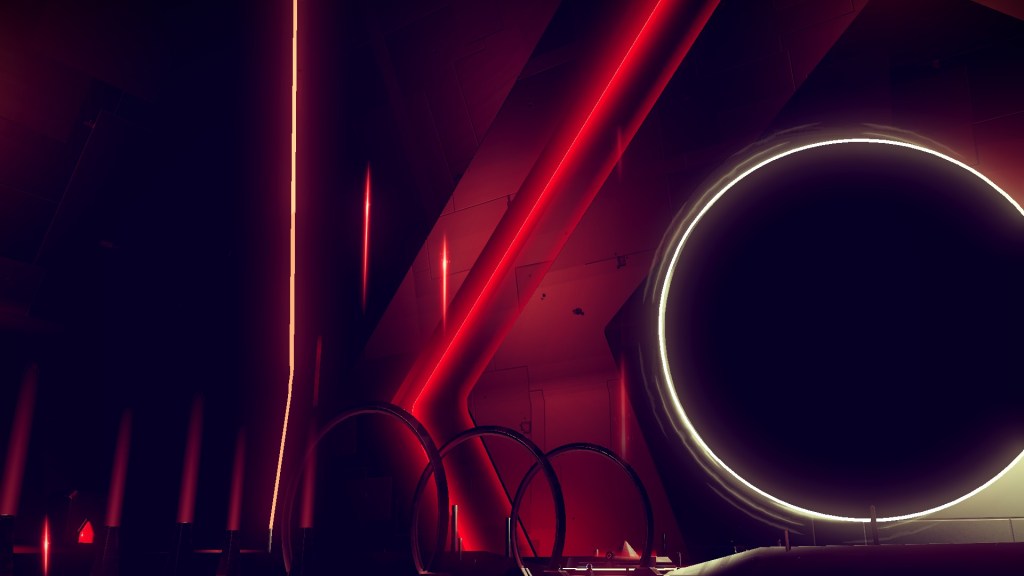
This is where the game goes from being a happy-go-lucky space exploration/survival game to being a sci-fi terror almost like “I Have No Mouth, and I Must Scream.” The first question the games’ god figure asks you is
“Did you enjoy my worlds?”
Suddenly the foreshadowing and the thematic elements all come together to smack the player in the face. The galaxy is just a giant simulation created by the Atlas for his travelers to explore and see, much like you the player have been this whole time, and just as you’re coming to grips with your non-reality (or maybe feeling like someone is looking at the world through your eyes) the next and final gut punch comes.
16.
The number that has been popping up everywhere is indicative of the fact that god is dying. More exactly, his hardware is breaking down and in 16 minutes the Atlas (and by extension all of reality) is going to die. Due to some Inception-style time dilation, some of the characters believe that you still have a long time (from your point of view) to explore the galaxy. The anomalous mission givers aboard the Space Anomaly even have a poignant look at it. All things end, after all, why not enjoy the time you have here?
It doesn’t quite end there though. You find that the main terminal for the Atlas is at the Galactic Center (the original exploration goal at launch) and may be able to fix the end of reality. There’s really no rush, while the sixteen minutes seem pressing, it’s more of a story element and you can meander as much as you want. Upon reaching the Galactic Center, you finally interface with the Atlas directly.
And they’re scared.
They have a Faustian deal for you. They are desperate to find some way to fix the malaise that plagues their hardware or software, but they need your help, and you need more time. So they’ll generate another galaxy for you to explore, and hopefully with the extra time they get by resetting the simulation they’ll be able to fix themselves. You can choose to accept and then the game “starts over” sort of like a new game plus, or you can decline and keep exploring the galaxy at will.
In short, the story is a poignant, thematic piece that is surprisingly thoughtful and emotional for this kind of game. I’ve read sci-fi short stories that have less depth and are less interesting than the implemented story for this game.
A Redemption Arc
No Man’s Sky is, in my opinion, the poster child for the success that can be brought by the live service games era. It would have been easy for the folks at Hello Games to accept that their launch product didn’t live up to the hype, slap a couple bug fixes on it and go back to the drawing board. Instead they managed to over time, not only provide the product we were all imagining when it was announced, but also earn its playerbases’ trust back.
If you ever had any interest in the game back in 2016, or gave it a shot then and didn’t care for it, I would implore you to pick up a copy and give it a whirl now. Not only is it a great space exploration game, it’s just a great game in general now. Additionally, they’re still releasing new content and adding new features with some frequency. It’s gotten to the point where Sean Murray can tweet out a single emoji and players will go crazy speculating what’s next.
Now I don’t think that we should look at this success story and cut big game companies slack for releasing clearly unfinished games. In this situation it’s clear that NMS is a labor of love and the developers and the studio truly loved their product, willing to put a lot of hard work into turning it into the great product it is today.
Conclusion
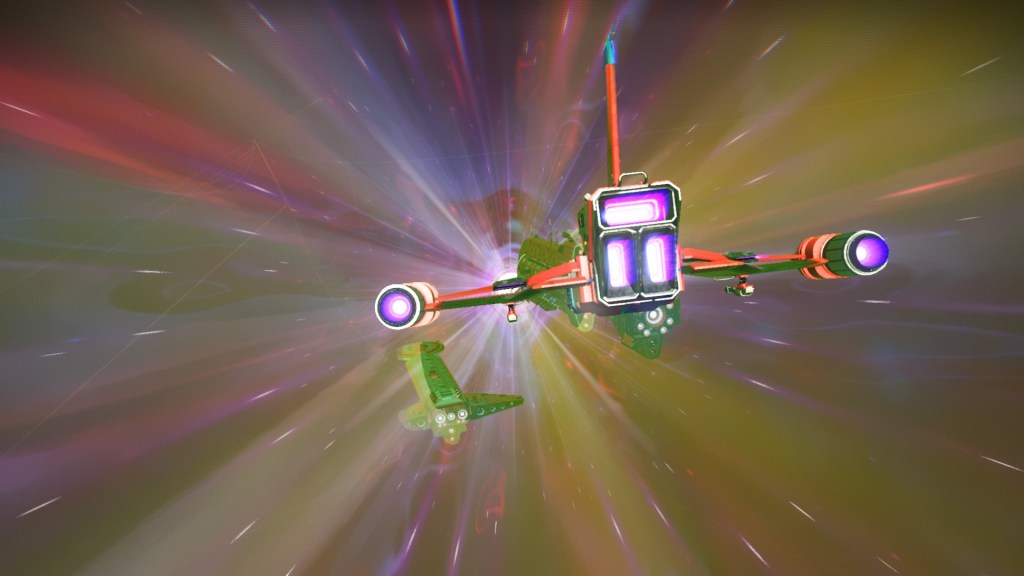
I’m glad that I gave this game another shot recently. Compared to some other games that I’m working my way through (more reviews to come!) it has the perfect balance between fun gameplay, but relaxed atmosphere. I can either go into a session planning on focusing super hard on a specific task, or just throw a podcast on in the background and do some space exploration.
I’m looking forward to seeing what other mechanics and updates will be added in the future and to see just how polished this game can really become. That being said, it is absolutely worth a playthrough or two as it is, and Hello Games deserve all the praise they’ve gotten for it since launch.
What do you think? Feel free to leave a comment below or to contact us on our contact page!
Final Score:
4.5 Cheese Wheels out of 5!
 The Queso Gamer
Leave a comment